If a tree falls in the forest, does it make a sound?
Or rather, if your product was recommended by a group of people at a party you were not invited to, would you still count the referral revenue?
We prioritize what is visible and measurable, and for obvious reasons. But what percentage of influence is invisible (at least when it concerns our click-based attribution systems)?
Another question – if Google were to roll out AI Mode to 100% of its experience, the universal interface by which users interacted with search, would it still be a valuable channel for marketers and brands? What if website clicks dropped by 50%? By 5X?
There’s no right answer to these questions, but they’re worthwhile thought experiments when it comes to AI search and the current measurement paradigm.
Note: just to be abundantly clear what my point is here. I do not believe that it’s wise to uproot everything you were previously doing and shift to some unproven or spammy “GEO strategy.” This essay does not even discuss tactical differences between practices. What I’m arguing here is that influence is not equivalent to website clicks, and by using website clicks, we underestimate the influence of LLMs in the purchase journey. Onward!
The Measurement Trap
We are a generation raised on clicks.
Our performance dashboards glow with charts and line graphs charting unique sessions, bounce rates, time on site. Every month we squint at referral breakdowns and organic lifts, trying to understand what moved the needle and what missed. And through all this, we’ve built our strategies, and our careers, on the promise that visibility is proxied by traffic, and traffic is a proxy for value.
But what if those proxies are starting to fail?
AI engines like ChatGPT, Perplexity, Claude, and Google’s own AI Overviews and AI Mode don’t behave like traditional search engines. They don’t operate on ten blue links. They aren’t structured to pass the user off to a publisher via click. They are designed to answer. Which, by their nature, means they are principally zero-click environments.
We should not be surprised that they send little traffic.
We should be concerned that we’re still using traffic as our primary measure of relevance.
If your mental model says, “value comes from traffic,” then 1% LLM traffic seems like a distraction. But if your model instead considers “value comes from influence,” then we have to confront the possibility that we are looking at the wrong signal.
A Restaurant Without a Keycard
Where Google has historically functioned as a bridge (input on one side, destination on the other) ChatGPT and similar tools offer more self-contained experiences. In the same way that calculators didn’t send you to arithmetic websites, LLMs are not built (at least primarily) to send you to pages that contain the answer. They are built to be the place where the answer lives.
Which means we’re dealing with a zero-click interface. And zero-click interfaces break our attribution models. Because the thing we’ve always used to detect success – the click – is no longer part of the interaction.
Clumsy analogy time.
Let’s say you run a restaurant, a busy little spot with a loyal customer base. For years, you’ve tracked guest traffic using a digital keycard system. Every customer swipes in when they arrive.
You know who’s coming, how often, at what times. Perhaps there’s even a component of these keycards that allows you to see, with some precision, how a customer found you (let’s call this a URL parameter). You’ve built dashboards. You’ve run campaigns. You’ve A/B tested the dinnertime menu based on Monday Night Football. It’s not perfect data, but it’s yours. You trust it.
Then, one day, you realize the keycard system is creating friction. People forget their cards. The tech is buggy. So you remove it. Guests still come. The dining room still fills. The waitstaff stays busy. The register rings. But now, you don’t know how many people walked through the door. You can’t see the foot traffic anymore.
Would you assume your restaurant is empty?
Of course not.
You would recognize that your measurement tool no longer reflects the reality of your business. The absence of telemetry is not the absence of behavior. It’s just the absence of data. And smart operators would adapt. They’d find new proxies. They’d watch the register. They’d listen to servers. They’d ask diners how they heard about the place.
Yet in marketing, we often fail to make this distinction.
We look at the clickstream and decide it is the stream. We look at referral traffic and believe it defines influence. We forget that when the medium changes, the signals we’re trained to look for may vanish – not because the influence is gone, but because it’s flowing through a new vessel.
The same number of people might still be “walking through the door” (discovering your product, forming a preference, making a purchase) but the door is now metaphorical. Maybe they came in through a side entrance. Maybe they read a summary on Perplexity and Googled your brand name instead. Maybe they asked ChatGPT, got a strong answer, remembered your company, and typed it in directly a week later.
The interface is different. So the path is different. And so the old map, the one that traces everything from organic search to landing page to lead form, is no longer as helpful as we want it to be, at least when it comes to LLMs.
The hard part is: we still want it to be.
We want clean lines. Measurable outcomes. Attribution you can show your CFO. But we’re entering a domain where the influence is upstream of measurable behavior. We are operating in a dark forest, lit only by scattered self-reports, directional brand visibility scores against self-selected prompts, referral traffic presenting only the tip of the iceberg, and a whole lot of faith shadows.
But if we continue to mistake the absence of clicks for the absence of presence, we will miss what’s actually happening.
Influence Without Telemetry
Our own research at Omniscient revealed that about half of B2B buyers are starting their purchase journeys in an LLM interface. That number will likely rise.
These prompts aren’t always high intent. In fact, many begin as problem-aware explorations:
- “How do I reduce churn in a PLG motion?”
- “Best ways to manage unstructured data?”
- “How do other companies structure their analytics teams?”
They sound like diary entries. And often, that’s exactly what these tools are being used as – private, probabilistic journals, personalized for each user. Sometimes they cite sources. Often they don’t. But make no mistake: they are shaping decisions.
In fact, recent research conducted by Omniscient’s Cate Dombrowski found that a significant percentage of the time (roughly ⅓ of the time for problem aware queries), LLMs are recommending brands without being explicitly asked.
Our own data shows this discrepancy. Roughly 5% of our website traffic comes from LLMs, which pales in comparison to our traffic from Google search.
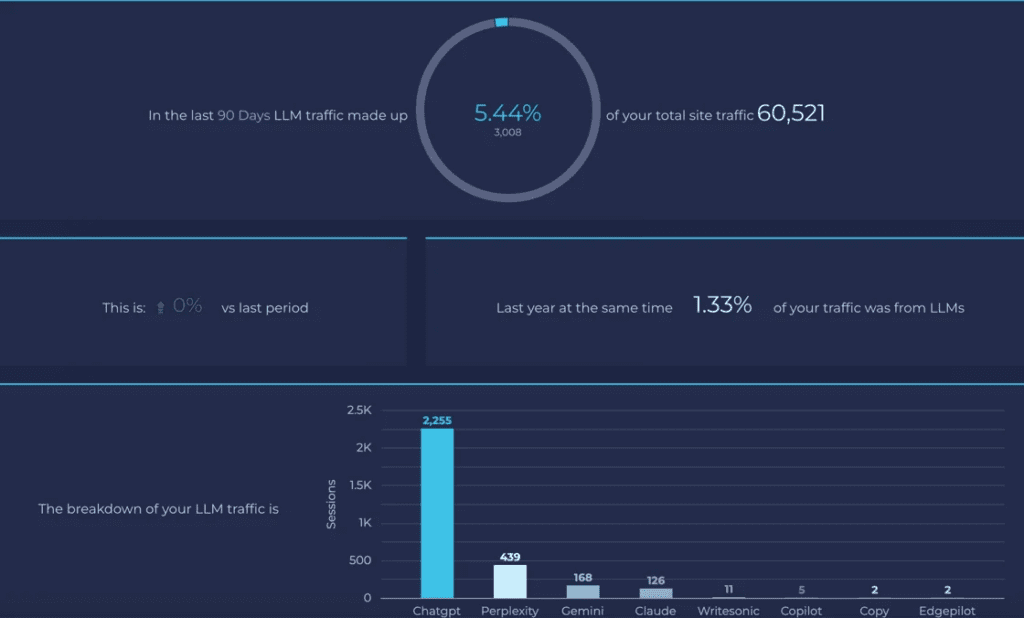
Similarly, we see a handful of leads coming in directly from LLMs each month (using click-based attribution in HubSpot and Google Analytics).
However, self-reported attribution tells a completely different story, with 30-40% of inbound leads stating they found us via an LLM. This is probably an underestimate, as many do not write anything on the web form, yet when asked in our discovery call how they found us, they will often say “oh, I was asking ChatGPT how to do…and I found you.”
Just because you can’t see the click, doesn’t mean the influence didn’t happen.
LinkedIn’s Lesson (or Chris Walker Redux)
Let’s take a detour.
Consider LinkedIn. How much website traffic does your average post drive?
For most B2B companies, the answer is: not much. A few clicks here, a spike there.
Yet we invest time, money, and effort into creating content on the platform, not for website traffic, but for presence. For narrative shaping. For recall. For community. And sometimes, to shitpost.
We accept, intuitively, that LinkedIn is a powerful tool for brand influence, even if it rarely triggers a session in GA4. This is what Chris Walker talked about for years. And today, most marketers are aware of this and treat LinkedIn social appropriately.
Towards Brand Gravity
This isn’t an argument against SEO. I don’t even care what we call AI search.
In fact, I believe, and we’ve seen, that great SEO is often great AEO (Answer Engine Optimization), with some marginal tactical differences that I’ve discussed at length on this newsletter.
If you’re creating great content, garnering high quality backlinks, have a technically sound and performant website with clean information architecture, this will translate well into AI search.
The key strategic difference is that LLMs require a broader remit.
Imagine you’re at a cocktail party. Someone asks the group, “Hey, does anyone know a good tool for managing remote teams?” A few people offer answers. One person says, “We’ve had a great experience with Basecamp.” Another says, “I think Notion added something like that.” A third mentions, “Honestly, Notion is great. It also does X, Y, and Z.”
Later that week, the person who asked the question might Google “Notion,” visit the site, poke around, and maybe even sign up. When they do, the analytics dashboard will show it as direct traffic, or perhaps branded search. But the real origin, the seed of influence, was the conversation (which, again, was influenced upstream of measurable behavior).
This is what AI engines are becoming.
They are scaled cocktail parties – probabilistic, personalized, and trained on the exhaust of the public internet. When someone asks, “What’s the best CRM for a B2B startup?”, the engine draws a myriad sources, including your website, but also from competitive blog posts, forum threads, help documents, product comparisons, YouTube transcripts, social posts, feature pages, and more.
In short: the answer space is trained on the ambient residue of what people have said about you, not just what you’ve published yourself.
This is the new game.
Not just to rank, but to be recallable & recommended.
We call this brand gravity.
The pull your company exerts across the market, not through traffic volume, but through narrative density (and accuracy). When someone in your category types a prompt into an LLM, are you likely to show up? Not because you’ve gamed the prompt, but because your presence is so persistent, so clear, so associated with the problem space that the engine can’t help but mention you?
That’s the goal.
And this kind of visibility isn’t built through keyword targeting. It’s built through ecosystem saturation. Through off-page content, product clarity, and repeated mentions in credible sources. Through clarity in your own materials and resonance in the words of others. It’s PR. It’s word-of-mouth. It’s technical documentation. It’s third-party reviews and customer quotes and “someone on Hacker News mentioned you once” posts. It’s the damned Surround Sound SEO thing I came up with in 2018, but now evident and broadening in scope.
Your brand’s presence in AI engines is less about keywords and more about gestalt. Are you known? Are you understood? Are you the brand people name in the digital cocktail party of a prompt?
Rewriting the Playbook: Adapting to the Invisible Shift
So we adapt.
Not by abandoning measurement entirely, but by broadening our lens and by acknowledging that attribution is no longer linear, no longer clean, and certainly no longer just about what shows up in last-click dashboards.
We start asking different questions.
- How often is our brand recommended in LLM outputs?
- Are the recommendations accurate and positive?
- How many leads self-report ChatGPT (or other AI engines) as the discovery source?
- Where are we being recommended, and by whom?
- What third-party sites shape the training data for AI models?
- What is our citation share for prompts that matter to our target customer base?
- What stories are circulating in the corpus that represent our category?
We experiment with new metrics: brand visibility in LLMs, citation share, brand mentions in citations (or Surround Sound SEO), qualitative perception audits, forum sentiment mining and social listening. None of these are perfect, but together, they provide a directional sense of presence.
We double down on messaging: making sure our product is described clearly, consistently, and distinctively across every possible surface. If a model can’t figure out what you do, neither will your buyer.
We build distributed presence: ensuring our expertise and narrative live not just on our domain, but in the places that shape answers (Reddit, Wikipedia, Quora, niche blogs, review sites, YouTube, etc.).
We prioritize depth over volume. The infinite content treadmill loses some of its appeal when the game becomes coherence, not cadence. Scarce, high-quality, hard-to-fake content (original research, voice of customer, technical deep dives) becomes a differentiator.
And most importantly, we get comfortable operating in a world of incomplete information.
We look at the register (pipeline, revenue) and if it’s holding steady, we resist the urge to panic just because the clickstream has diminished. We trust the forest even when we can’t see every tree.
Malte Landwehr said it plainly in a recent LinkedIn comment:
“I fully agree that betting on AI search should not mean completely neglecting traditional search engines. Especially since at least 50% of AEO (or GEO or AI SEO) is just traditional SEO anyways.
But I want to add one perspective to the 2-3% of Google traffic number. I believe that is the wrong metric. 35% to 40% of Google searches lead to a click. With ChatGPT, AI Mode & Co, this number is much lower. Somewhere in the 1% to 5% range. (Source: SimilarWeb, Semrush, Growth Memo, Promptwatch, Peec AI, etc.)
If you receive 1% of your clicks from ChatGPT that could mean 30% of relevant questions are already asked there.
I have seen cases where 20% of new leads self-identified as “I found you via ChatGPT” when ChatGPT was less than 1% of traffic.”
If there’s a single question to guide our next phase of marketing strategy, it’s this:
When your buyer sits down at the proverbial cocktail party – or types a question into the glowing rectangle – is your name the one that comes up?
Want more insights like this? Subscribe to Field Notes