
What happens when anyone can press a button and generate a blog post?
That’s the question we asked when ChatGPT was launched.
We were working with Jasper at the time, so we had a front row seat to the first big consumer wave of generative AI.
Promises popped up, such as eliminating writer’s block, helping revise paragraphs, and at the extreme, publishing entire blog posts.
And while many marketers incorporated AI into their creative workflows, the extreme promise of publishing entire pages didn’t come to fruition in a meaningful way (barring the SEO Heist and other chicken bones in the garbage disposal tactics we saw).
However, the models got better. People built platforms making it easier to build programmatic (or semi-programmatic) workflows. You can root your outputs in custom documentation around your product, brand, and subject matter expertise.
Now, it’s possible to leverage AI to produce content at a higher scale and that content is…not bad. If you focus on the right inputs, it’s actually pretty good.
That’s just content creation. Think more broadly about all the bits and pieces, the nodes and processes that lead to creative work across SEO, content marketing, PR, and growth more broadly.
There are many ways in which technology can and will reduce the cost and time of certain actions.
And for a short time, there’s probably an advantage to doing this if you’re an early mover.
But as quoted above, “time always erodes advantage.”
If my LinkedIn posting agent is interacting with your LinkedIn posting agent, and everything on LinkedIn is posted by an agent, together we have eliminating the value (or at least the individual advantage) to posting on LinkedIn.
In other words, there are things brands need to do to survive that do not produce distinct advantages against other brands. And there are things brands need to do that produce distinct advantages. These are usually not the same things.
Containerization, The Fosbury Flop, and A/B Testing
In the 1950s, a trucking entrepreneur named Malcolm McLean introduced a deceptively simple idea: standardize shipping containers so cargo could move seamlessly from truck to ship to rail.
The impact was enormous.
Containerization cut shipping costs by more than 90%, radically sped up ports, and made modern global trade possible. Early adopters gained real advantage. Certain shipping companies and ports surged ahead while others scrambled to catch up.
And then the advantage vanished.
Once containerization became the standard, everyone adopted it. Ships were redesigned. Ports rebuilt their infrastructure. Logistics networks reorganized around the same efficiencies. What was once a breakthrough became table stakes.
Containerization didn’t fail. it succeeded so completely that it erased itself as a source of differentiation. It raised the global baseline and compressed margins everywhere it touched.
We’ve seen this across disciplines.
The Fosbury Flop, once novel to the point that it was laughed at, is now the standard high jump technique.
My side obsession is health and fitness, and you see constant cat and mouse dynamics here.
As a crude example, imagine the first bodybuilder to figure out steroids. Massive advantage that then erodes as everyone else starts using them. Now you’re seeing this with esoteric stuff like peptides and fitness trackers.
Closer to home, this is what happened with A/B testing.
Of course, randomized controlled trials have a long history. But at one point, it was difficult, expensive, and rare to conduct them on websites and apps.
In the early web era, running a trustworthy A/B test was hard. You needed enough traffic, reliable instrumentation, careful randomization, and the engineering muscle to ship and measure variants without breaking production.
That’s why the first serious experimentation cultures emerged inside the handful of companies that could afford the infrastructure (Amazon and Microsoft most famously). In a seminal survey/practical guide, Ronny Kohavi and colleagues describe how Amazon’s culture (“data trumps intuition”) combined with a system that made experiments easy to run, creating a meaningful innovation advantage over teams still debating changes by committee.
Microsoft’s answer was to industrialize experimentation. Their Experimentation Platform (ExP) was explicitly built to “accelerate innovation through trustworthy experimentation,” turning what used to be bespoke analysis into a repeatable internal machine.
Then, the advantage spread more widely. Culturally, it became much more common and popular to talk about experimentation across product, marketing, and broader business units. Technically, it became easier for any given team to run experiments, especially as the SaaS layer built tools to abstract away much of the hard engineering problems.
Optimizely is a clean marker of that first democratization wave.
When it launched, the pitch wasn’t “become an elite experimentation organization.” It was: run A/B tests on your website without heavy engineering – “remarkably easy” compared to the bespoke stacks inside big tech. Dan Siroker (Optimizely’s cofounder) even frames the origin as building the product he wished existed “to make it easy for anybody to do A/B testing.”
On AI, Organic Growth, and Alpha Decay
Every tactic has a half-life.
Someone discovers a trick (a new content format, a link building method, a way to game an algorithm) and for a window it works beautifully. Then everyone copies it. The platform adapts. The advantage decays to zero (and sometimes reverses if the tactic is particularly spammy).
Think about how this plays out across three dimensions.
First, the cat-and-mouse game with platforms.
Google updates its algorithm. SEOs adapt. Google updates again. This cycle has been the defining rhythm of the industry for decades, from keyword stuffing to link schemes to the Helpful Content Update. The same dynamic is now playing out with AI search, optimizing for LLM citations, getting mentioned in AI Overviews, and with social algorithms that reward whatever format they’re currently boosting (carousels or videos on LinkedIn, Reels on Instagram, whatever TikTok is doing next week).
Second, the arms race with competitors.
Remember the Skyscraper technique? Find a top-ranking page, make something longer and better, build links to it. It worked. Then every content marketer on the planet did it, and now the SERPs are full of 5,000-word behemoths no one actually reads. The tactic didn’t stop working because it was bad. It stopped working because it was effective enough for everyone to copy.
Third, the novelty effect with the consumer.
I’m highly conscious of this because of my past work in experimentation, where a brand would discover an interesting UI module or experience. Because of its novelty, it would convert like crazy, only to regress to the mean as audiences became used to the experience. In the crudest sense, think of an exit intent popup. The first one probably converted at like 30%. Today’s exit intent popup might convert at 1%.

We’re seeing the same thing with AI content right now.
The early movers who used LLMs to scale programmatic pages (self-promotional listicles, comparison pages, glossaries) saw real gains in AI search visibility. But the arbitrage window eventually closes as the three dynamics above play out. As more companies adopt the same playbooks and the same tools, the output converges. The tactic becomes table stakes.
There’s a concept in finance known as alpha decay, which is the gradual loss of a trading strategy’s predictive edge over time, often because the strategy becomes widely known, leading to market crowding, or due to overfitting to historical data.
How to deal with alpha decay is a challenge, but I like what this Reddit comment advises and think it will do us well in organic growth, too:
“Bring a Long Term perspective. Cancels out any short term vol swings.
And diversify.”
The Early Mover’s Advantage
“Life is a Sisyphean race, run ever faster toward a finish line that is merely the start of the next race” ― Matt Ridley, The Red Queen
A short term advantage is still an advantage, and if it’s in the right context, the early wins could compound into a longer term lead.
This is, in a nutshell, the early mover’s advantage.
It’s most impactful in areas that have network effects, compounding results, or emergent benefits.
For example, everyone is podcasting now. To start podcasting early was to toil in obscurity, but over time, to build up an owned audience of subscribers that is a distinct distribution advantage even though the field has grown saturated.
In SEO and, now, AI search, there are cumulative advantages that build up due to virtuous cycles or flywheels.
Very simply: you write content which ranks on SERPs, which accumulates backlinks, which makes it easier for you to write more content that ranks on SERPs, which accumulates more backlinks.
In AI search, I’ve written about the Matthew Effect of brand mentions.
In effect, if your brand is mentioned in relation to a category early on, it’s likely that you’ll be mentioned more in the future. This is because many content producers use AI (or search) as their research vehicle. If every brand then swarms on a tactic, like say self promotional listicles, then your brand, as a function of being present early, will benefit from the tactical swarm.
So while the individual tactic – the ultimate guide, the listicle, the programmatic glossary pages – may fade, there are certain cases where seeing the arbitrage early and exploiting it will still provide a longer term advantage.
For example, HubSpot was clearly out over their skis with the topics they covered and their content planning. They were very publicly criticized for this as their traffic eroded. But through those years of traffic dominance, they built a lot of links, collected a lot of emails, and their orange logo flashed in front of millions of people. Short term advantage gone, but long term embers still burn due to emergent benefits.
In a sense, the meta tactic of speed and agility is the real differentiator, as the tactical layer – if not fungible – is ephemeral.
Red Queen Versus Blue Ocean
“The struggle for existence never gets easier. However well a species may adapt to its environment, it can never relax, because its competitors and its enemies are also adapting to their niches. Survival is a zero-sum game.” ― Matt Ridley, The Red Queen
Red Queen dynamics are all over marketing, which is natural and not something to avoid. Surviving – literally, as a company, but also abstractly, as being part of the conversation and general thread – is winning in some sense.
But Red Queen tactics are often quite different from those creative plays that cause a distinct advantage or differentiation.
From first principles, unless you have a unique advantage (like limitless capital or connections), then doing the same things that everyone else is doing can only really serve to equalize or reach a median value.
What, then, for standing out?
We’ve riffed on this idea of Red Ocean versus Blue Ocean SEO before, where we distinguished crowded markets and organic playing fields from those with more open space (and thus, uncertainty).
More broadly, the things you do to stand out will often look irrational or counterintuitive at first glance.
As Rory Sutherland put it in Alchemy, “The opposite of a good idea can also be a good idea.”
Of course, the risk is higher when you walk your own path. There’s a non-zero chance that there will be zero positive results. But the upside, too, is much higher, as you have successfully veered away from the market crowding dynamics of Red Queen effects.
The Barbell Strategy, Revisited
In that sense, I still love the Barbell Strategy.
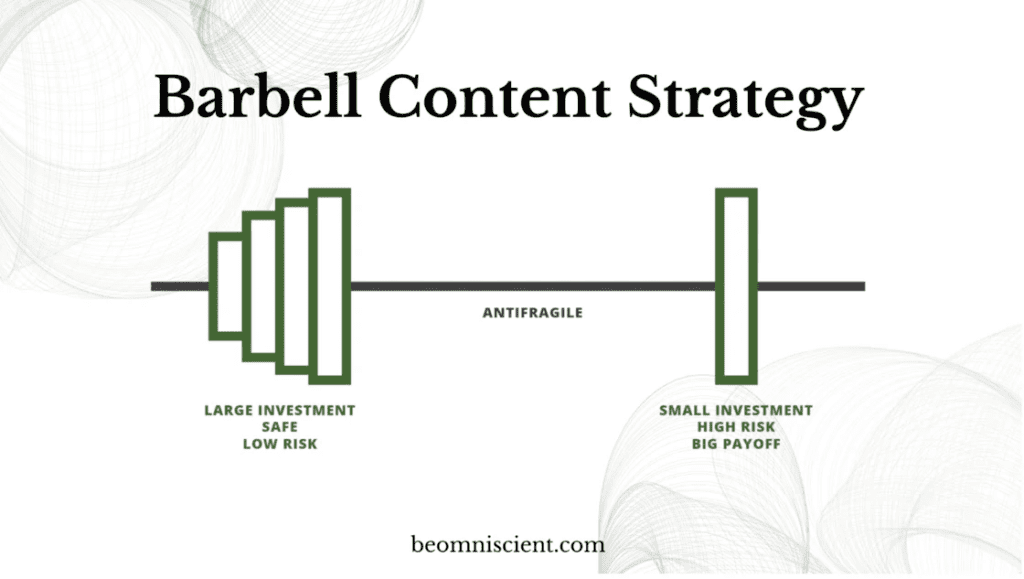
The simplified model here is that you index on the two extremes of the volatility spectrum: mostly those safe bets with little downside (but capped upside), and then a smaller percentage invested in high upside but very uncertain bets.
We borrowed the idea from Nassim Taleb, who used it to speak about financial investments, and we first applied it to content planning. Index on predictable SEO topics related to your product, and then also flashy and buzzworthy campaigns with little data to justify them, high upside potential.
This can be popped up one layer higher to marketing itself, which is, in other words, to invest in channels and tactics that are fairly safe and stable to form a defensible position. To avoid going bust. But then to build exposure to higher risk but higher upside bets gives you the opportunity to accelerate past the median.
What’s this look like in practice?
Writing a lot of bottom of the funnel content, but also producing an expensive and high quality magazine. Producing absurdist and comical video campaigns and then building out a predictable organic engine to bolster this differentiation. Hosting extravagant dinners while running a personalized cold outbound program.
Adopting AI workflows for content briefs, automating workflows, scaling production. These are efficiency gains. Without grounding in strategic differentiation (or, in our opinion, heavily rooted in voice of customer and customer research), they do not fundamentally solve problems of relevancy, quality, or differentiation. Or more cynically, if publishing 10 poor quality pages per month didn’t work, publishing 100 bad pages per month probably won’t either.
Still, adopting technology and improving efficiency is the right call. But they’re not differentiation. Everyone with a credit card and an API key has access to the same models, the same tooling, the same playbooks. Efficiency gains keep you in the race. They don’t win it.
What wins is distinction. Original research. A proprietary data set. A point of view that stands out and a distribution strategy to echo it beyond your own website. A brand that people seek out rather than stumble into. Doing things worth talking about. These are the things that compound. They’re also the things that can’t be copy-pasted.
So the practical framework looks something like this: invest in Red Queen tactics for efficiency and parity. You need them. Not doing them is falling behind. But allocate real energy toward the things that jump you past the median: the asymmetric bets, the stuff that’s hard to do and therefore hard to copy.
Want more insights like this? Subscribe to Field Notes